Tell the Time Sheets
Once children can read o’clock and half past, the harder steps are saying the time in words, reading to the exact minute, and linking the clock face to digital and 24-hour times. These tell-the-time sheets focus on exactly those steps, with an hour-hand-only starter page for beginners, time bingo for the classroom and full answer keys.
Tell the Time Sheets
Printable tell-the-time sheets: hour-hand-only starters, time in words, reading to the minute, analogue–digital matching, a.m./p.m. sorting, 24-hour conversion and time bingo, all with answer keys.
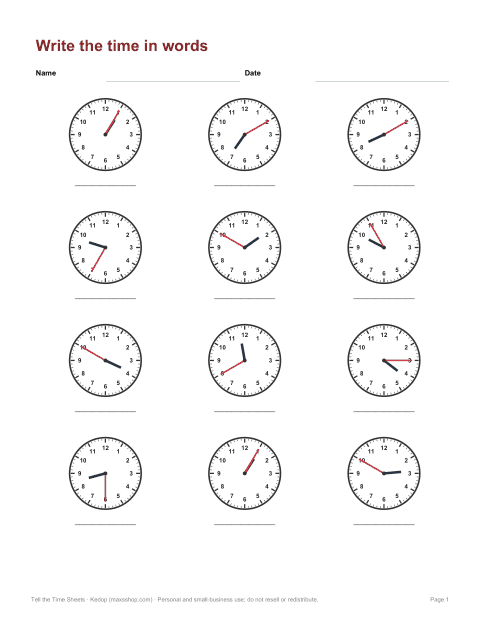
- Time in words (PDF)
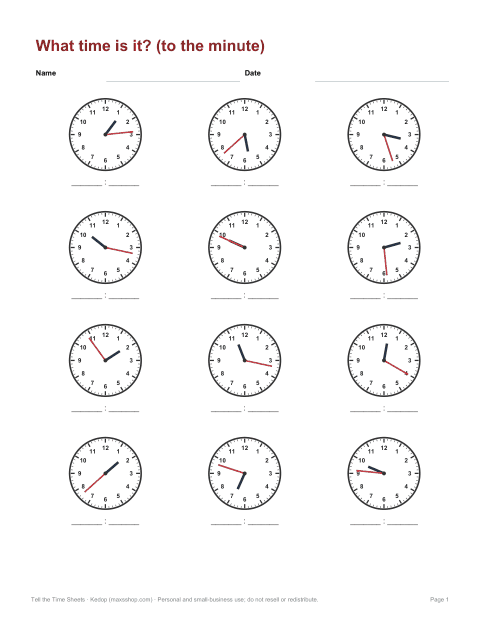
- To the minute (PDF)
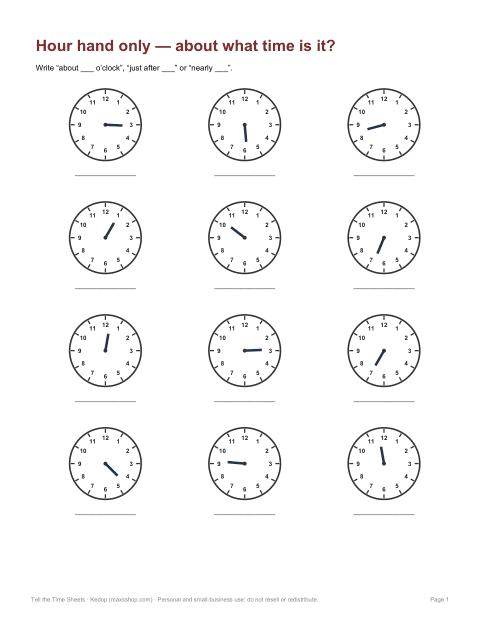
- Hour hand only (PDF)
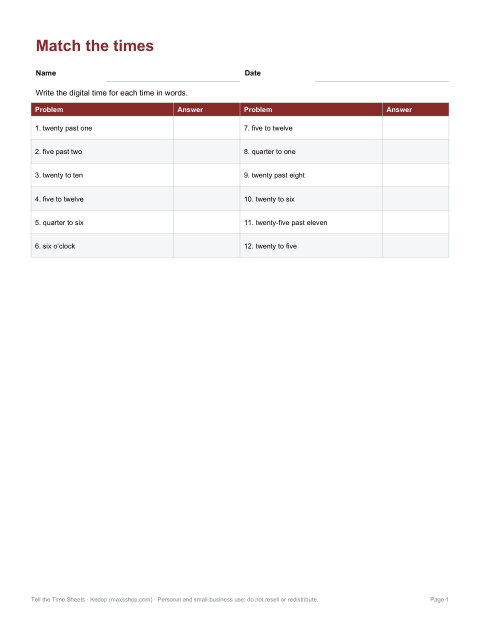
- Digital matching (PDF, DOCX)
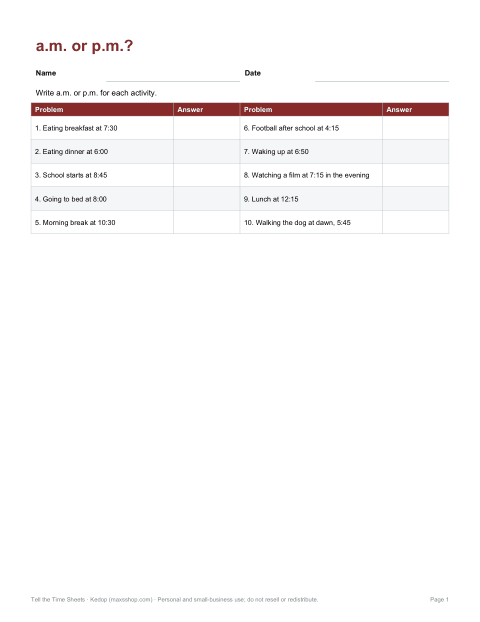
- a.m. and p.m. (PDF, DOCX)
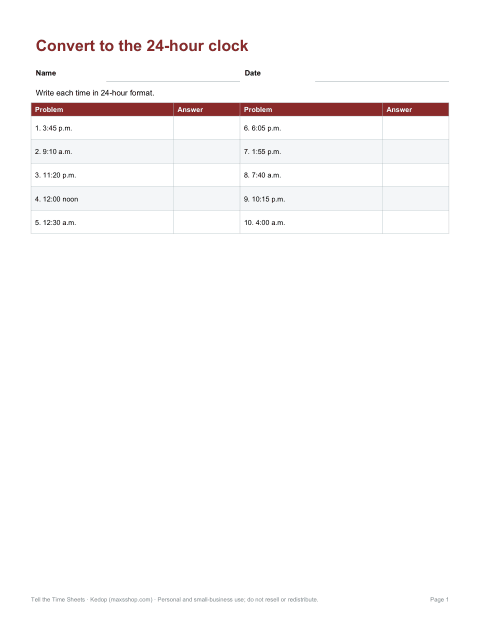
- 24-hour conversion (PDF, DOCX)
- Bingo card 1 (PDF)
- Bingo card 2 (PDF)
- Bingo card 3 (PDF)
- Bingo card 4 (PDF)
- Bingo card 5 (PDF)
- Bingo card 6 (PDF)
- Bingo caller list (PDF)
Formats: PDF, DOCX. Instant download after payment (link valid 72 hours, up to 5 downloads). AI-assisted: the templates were drafted with AI help and reviewed and laid out by Kedop.
$5.00 USD, one-time
Secure card checkout by Stripe. Full refund within 7 days — see the refund policy and license.
What the sheets cover
- Hour-hand-only clocks — estimate “just after three” or “nearly five” before minutes are introduced.
- Time in words — read a clock and write “twenty-five to seven”.
- To the minute — twelve clocks per sheet at times like 4:37 and 11:08.
- Analogue–digital matching — draw lines between clocks and digital displays.
- a.m. and p.m. — sort daily activities into morning and afternoon or evening.
- 24-hour clock — convert 3:45 p.m. to 15:45 and back.
- Time bingo — six different bingo cards with clock faces and a caller list.
Saying the time in words
| Clock shows | Digital | In words (UK style) | Often said (US) |
|---|---|---|---|
| minute hand on 12 | 1:00 | one o’clock | one o’clock |
| minute hand on 3 | 1:15 | quarter past one | quarter after one / one fifteen |
| minute hand on 6 | 1:30 | half past one | one thirty |
| minute hand on 8 | 1:40 | twenty to two | one forty |
| minute hand on 9 | 1:45 | quarter to two | quarter of two / one forty-five |
| minute hand on 11 | 1:55 | five to two | one fifty-five |
In British English, times after the half hour are usually said as minutes “to” the next hour; in American English many people simply read the digits, as in “one forty-five”. The sheets use the “past” and “to” wording, with a digital box alongside so both styles are practised.
Common mistakes and how to fix them
| Mistake | Why it happens | What helps |
|---|---|---|
| Mixing up the hands | Both hands point at numbers | Say “short hand, hours; long hand, minutes” and use hour-hand-only clocks first |
| Reading 2:50 as 3:50 | The hour hand is close to 3 | Ask “has it reached 3 yet?”; the hour hand only passes a number at o’clock |
| Reading the minute number as minutes | “It’s pointing at 4, so 4 minutes” | Count round in fives from 12 |
| Getting “to” times wrong | Counting forwards not backwards | Count back from 12 to the minute hand and name the next hour |
The 24-hour clock
Timetables, phones and many countries use the 24-hour clock. Morning times stay the same (09:30), and for afternoon and evening times you add 12 to the hour: 3:45 p.m. is 15:45 and 11:20 p.m. is 23:20. Midnight is 00:00 and noon is 12:00. To go back, subtract 12 from any hour above 12. The conversion sheet includes a number line from 00:00 to 24:00 to show both systems side by side.
Suggested order of practice
- Hour hand only: estimate times.
- O’clock and half past with both hands.
- Quarter past and quarter to.
- Five-minute steps and time in words.
- Reading to the minute.
- Digital matching, a.m./p.m. and 24-hour conversion.
Making practice stick
- Keep a real analogue clock in the room and ask “what time is it?” at natural moments.
- Link times to routines: lunch at quarter past twelve, bedtime at half past seven.
- Use a geared practice clock so the hour hand moves correctly with the minute hand.
- Play time bingo or “beat the clock” games for quick recall.
- Little and often: five minutes a day works better than one long session.
Formats and printing
All sheets are PDF, sized for US Letter and A4, with answer keys on the following page. Clock faces are large and clear for young children.
AI-assisted content
Worksheets were generated with AI assistance using a scripted clock drawing, and the answer keys were checked by Kedop.
Frequently asked questions
What age do children learn to tell the time?
Many start with o’clock and half past around 5–6 and read to the minute by about 8, but children vary.
What is “twenty-five to seven” in digital?
6:35.
How do I convert p.m. times to the 24-hour clock?
Add 12 to the hour, so 4:10 p.m. is 16:10.
Are answer keys included?
Yes, for every sheet.
Do the sheets use US or UK wording?
The “past/to” style, with digital times alongside.
Is this a subscription?
No, it is a one-time download.